Introduction A 40.5kV outdoor vacuum circuit breaker is the outgoing switch for a 35kV system, the class most distribution networks in China, Central ...
A 40.5kV outdoor vacuum circuit breaker is the outgoing switch for a 35kV system, the class most distribution networks in China, Central Asia and parts of Africa run at. Buyers compare three numbers: rated voltage, rated current, breaking capacity. Those three are also the hardest to get wrong.
What decides whether a unit survives twenty-five years of dust, salt fog and −30 °C mornings is insulation level, creepage distance and how well the mechanism box is sealed. None of the three appears on a quotation. This guide sets out what to check, in what order, and which lines to put in the enquiry.
For the calculation behind the numbers, see our guide on how to select a vacuum circuit breaker; this article covers the 40.5kV thresholds themselves.
A quotation can be wrong about a voltage system rather than a number, and that error decides whether the datasheet can be read at all.
40.5kV is the rated voltage of the equipment, equal to the highest voltage for equipment. The system it serves is 35kV; there is no 40.5kV network. So “35kV vacuum circuit breaker” and “40.5kV VCB” name the same unit, and a page should carry both.
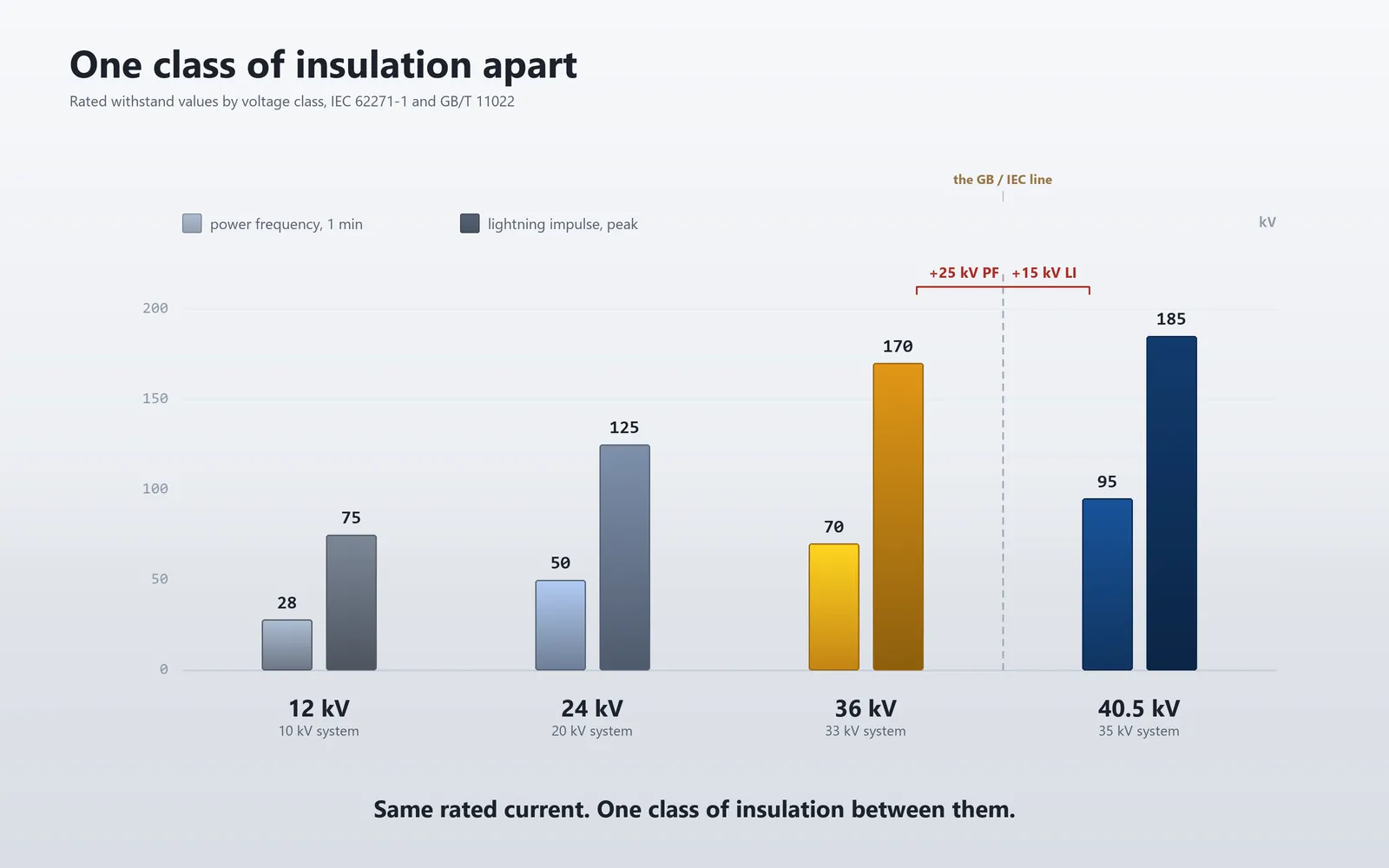
The two classes look close in name and sit one step apart in insulation.
Table 1 — Two voltage classes, two insulation levels
|
Item |
40.5kV (GB and IEC, China system) |
36kV (IEC international system) |
|
Nominal system served |
35kV |
33kV |
|
Power-frequency withstand, 1 min |
95kV |
70kV |
|
Lightning impulse withstand, peak |
185kV |
170kV |
|
Common breaking currents |
25 / 31.5kA |
25 / 31.5kA |
|
Typical markets |
China, Central Asia, parts of Africa |
Middle East, Africa, Southeast Asia |
The reading is asymmetric. A 40.5kV unit on a 33kV project is over-specified but safe; a 36kV unit tendered into a 35kV project is one class short and will be rejected. Such mismatches are a recurring reason overseas shipments fail acceptance, and rarely a product fault: one system written into the enquiry, another manufactured against it.
Figure 1 — Four voltage classes against insulation level: same current, different insulation
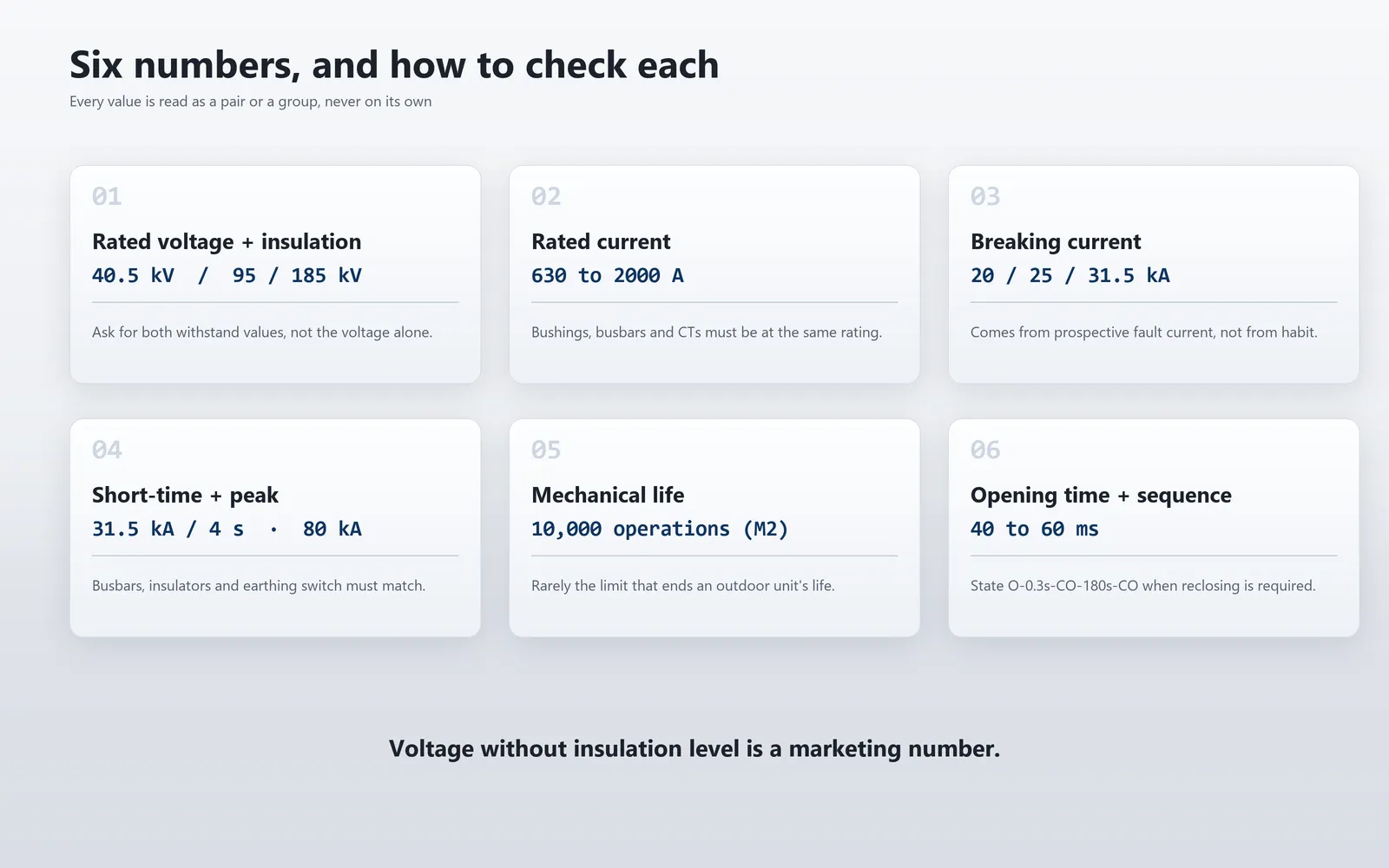
Six figures decide whether a unit fits a project. Each is read as a pair or a group, never on its own.
Rated voltage means nothing without its insulation level. A unit described as 40.5kV with no withstand values passes any comparison that looks only at voltage. Require both values on the quotation.
Common ratings are 630, 1250, 1600 and 2000A. Select on maximum continuous load plus a defensible growth margin, then check bushings, busbars and CTs at the same rating: a 2000A breaker behind 1250A bushings is a 1250A installation.
20, 25 and 31.5kA are common. The figure comes from the prospective fault current at the installation point, derived from system short-circuit capacity. It also belongs with short-time and peak withstand; checked alone, dynamic stability can fall short.
Quoted as a pair, for example 31.5kA for four seconds with an 80kA peak. They describe what the unit absorbs while the fault is still on. Busbars, support insulators and earthing switch must be at the same level.
About 10,000 operations at M2 class is typical. Mechanical life is neither electrical nor service life: on outdoor substations that budget is rarely spent, while humidity, pollution and seal ageing set the pace.
Opening time is typically 40 to 60 milliseconds, with the arc cleared inside two half-cycles at 50Hz. The operating sequence — open, 0.3s, close-open, 180s, close-open — governs auto-reclosing and should be stated by any automated project.
Figure 2 — Six numbers on one card: the value, the typical range, and how to check it
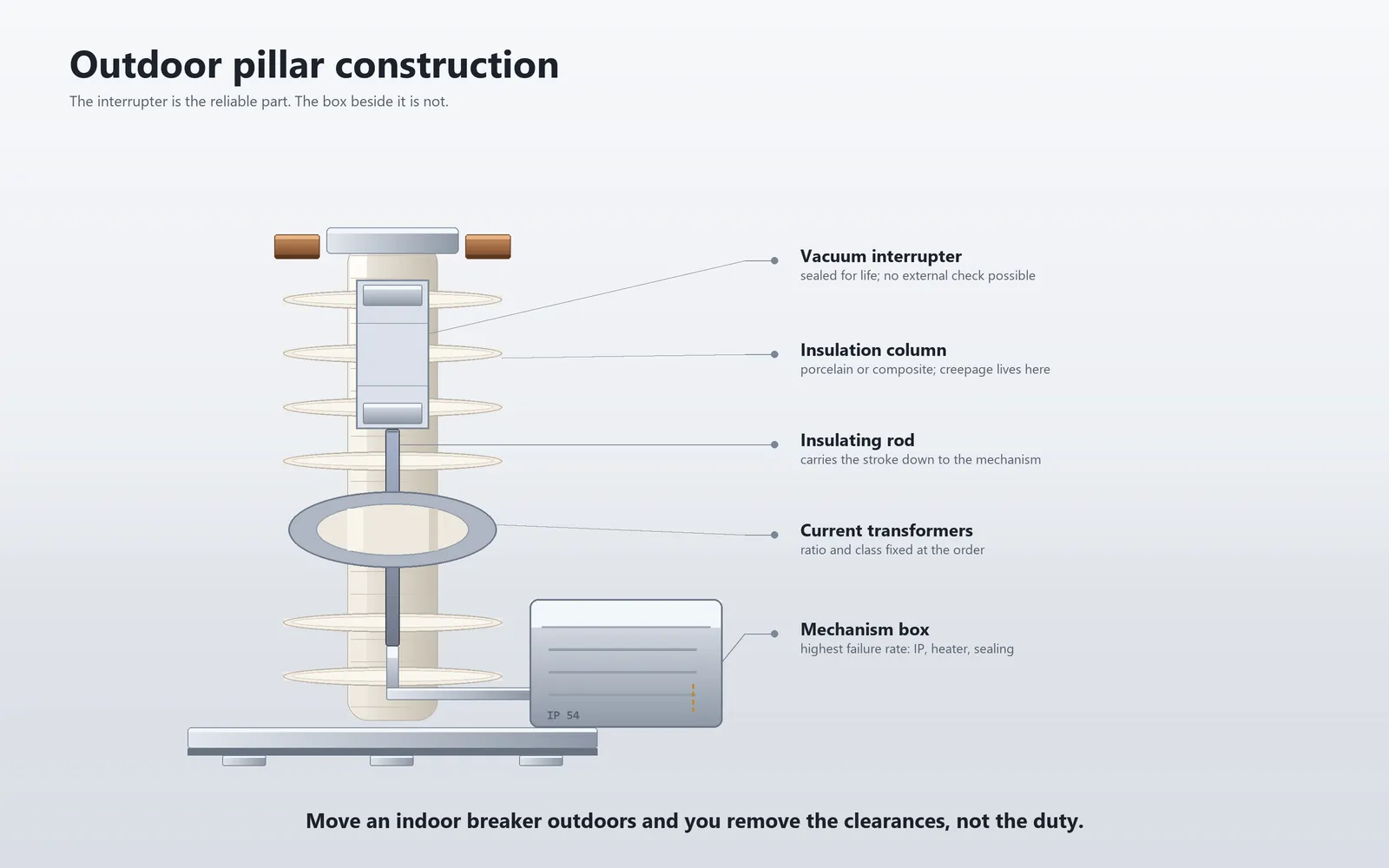
An outdoor unit is not an indoor unit in a housing. Three structural differences carry most of the price gap and most of the field failures.
The pillar design encloses the interrupter in a porcelain or composite housing, so external insulation carries overvoltage and surface pollution, a duty an indoor breaker never has. Indoor designs rely on cubicle clearances; moving one outdoors removes the clearance without adding insulation, and that is where retrofits fail.
Composite is lighter and better in pollution and impact; porcelain has the longer record in mechanical strength and UV ageing. Dusty or salt-fog sites often justify composite.
The mechanism box, not the interrupter, is the highest-failure part of an outdoor unit. Four items decide how it behaves: IP rating, anti-condensation heater, sealing and breathing, corrosion protection. In dust and wide temperature swings, condensation inside the box lowers secondary insulation and produces refusal to operate.
Current transformers are usually integrated on the bushings or the base frame; ratio, accuracy class and quantity must be fixed at order. Integrated FTU or DTU brings power supply, communication and protocol into the same order rather than into commissioning.
Figure 3 — Outdoor pillar construction: bushing, interrupter, insulating rod, mechanism box, current transformers, base frame
A catalogue quotes standard reference conditions; a site supplies the real ones. The gap is where acceptance problems begin.
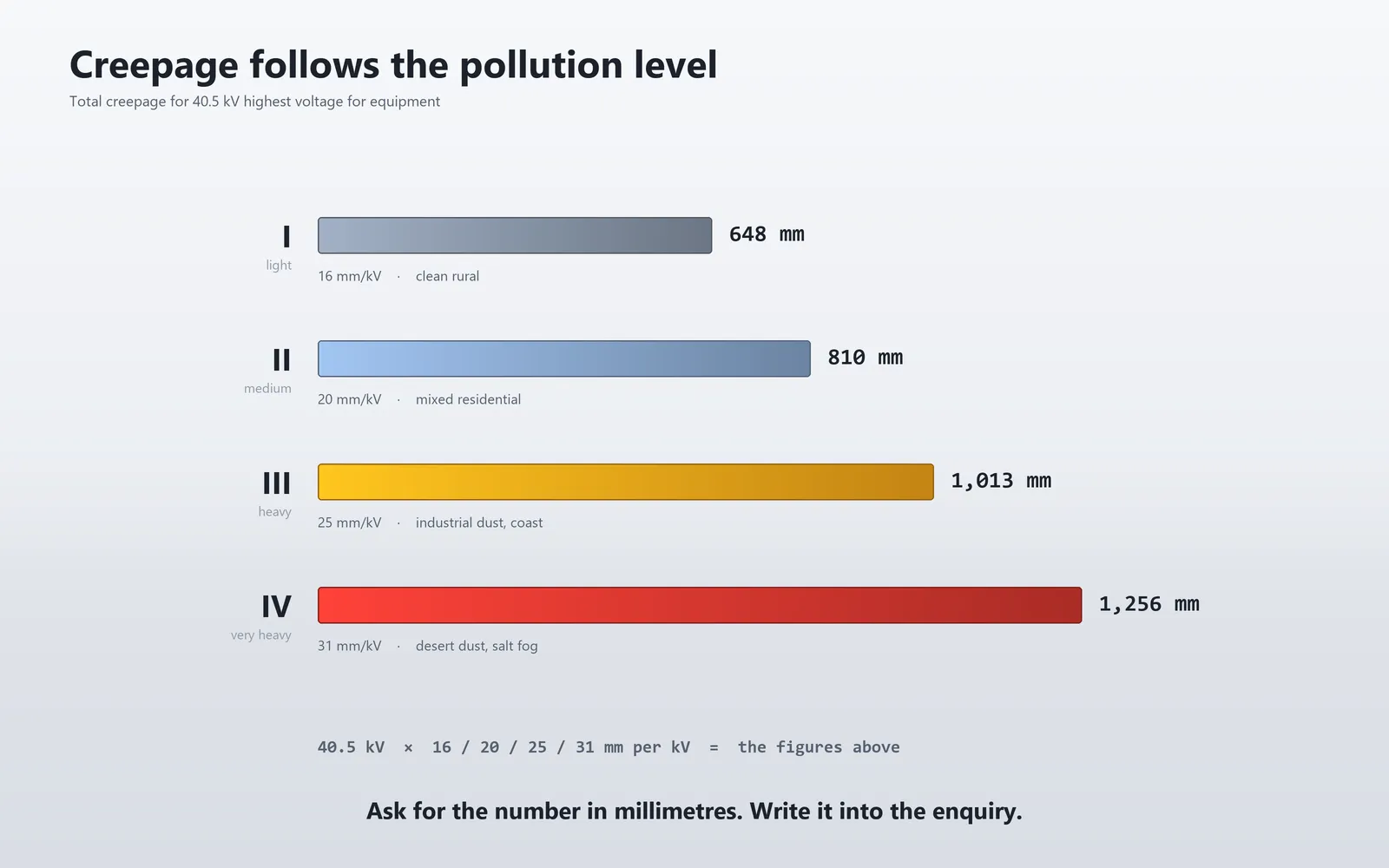
Creepage follows the pollution level and the highest voltage for equipment. At 40.5kV the four levels are narrow enough to write into the enquiry directly.
Table 2 — Pollution levels and the total creepage they imply at 40.5kV
|
Level |
Specific creepage |
Total at 40.5kV |
Typical site |
|
I — light |
16 mm/kV |
about 648 mm |
Clean rural |
|
II — medium |
20 mm/kV |
about 810 mm |
Mixed residential |
|
III — heavy |
25 mm/kV |
about 1,013 mm |
Industrial dust, coast |
|
IV — very heavy |
31 mm/kV |
about 1,256 mm |
Desert dust, salt fog |
Middle East dust, coastal salt fog and industrial sites belong at level III as a floor, level IV in most cases. Ask for total creepage in millimetres; “anti-pollution type” cannot be measured at acceptance.
Figure 4 — Pollution levels I to IV: the creepage a 40.5kV column has to provide
Reference conditions are typically −25 to +40 °C; Gulf and inland African sites reach +55 °C, with desert nights below −10 °C. High ambient means derating, faster seal ageing and different heater logic.
Above 1,000 m, external insulation must be altitude-corrected per IEC 62271-1. That correction is cheap at quotation and impossible later.
Wind speed, ice thickness and seismic level size the base frame, column and anchor pattern. Typhoon and icing regions need heavier frames, and the figures belong in the agreement.
A datasheet takes three minutes to test, and what it leaves out matters more than what it contains.
Eight items make a datasheet usable: rated voltage; insulation level with both withstand values; rated current; breaking current; short-time and peak withstand; mechanical life; mechanism type and control supply; creepage and IP rating.
l Only three numbers given — voltage, current and breaking current, everything else deferred to “refer to catalogue”. Usually a sign that no complete type test stands behind the model.
l Insulation level written as “conforms to IEC” with no values. A compliance statement describes a design family, not the unit quoted.
l Creepage, IP rating or mechanism model missing. These are where cost is removed quietly, and where it returns once the order is firm.
Every number should have a counterpart in a type test report. Read the report for the issuing laboratory, whether the tested specimen matches the model ordered, and the date against the current standard. A report for a sister model proves the family, not the unit.
A datasheet is a claim; a type test report is the evidence.
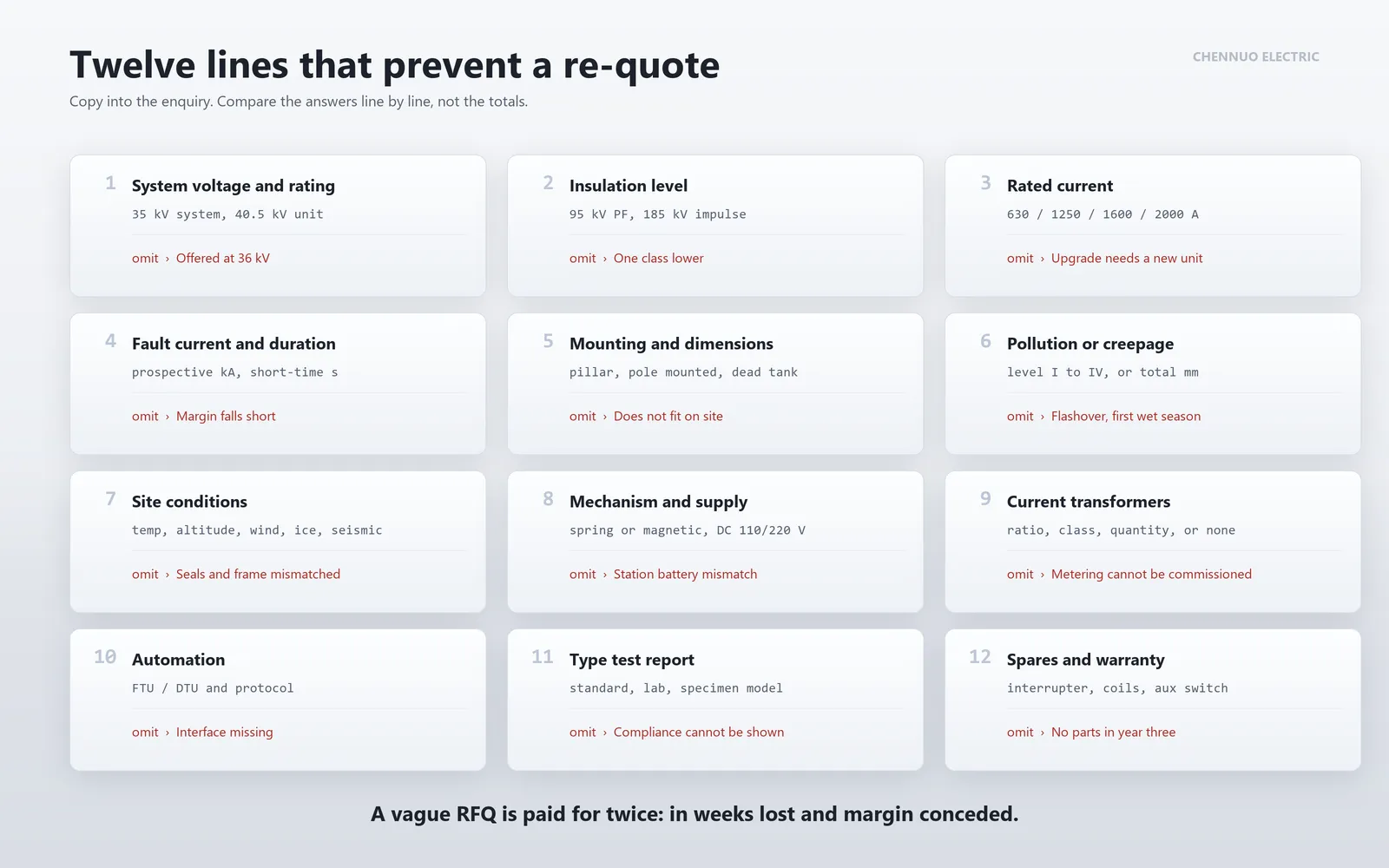
Most re-quotes are not price negotiations. They are the cost of a vague enquiry, paid twice: in weeks lost and margin conceded.
Table 3 — Twelve lines for the enquiry, and what leaving each one out costs
|
# |
Line to write in the enquiry |
What omitting it costs |
|
1 |
System voltage and equipment rating (35kV system, 40.5kV unit) |
Offered at 36kV, fails acceptance |
|
2 |
Insulation level: 95kV power frequency, 185kV impulse |
One class lower arrives |
|
3 |
Rated current, and whether growth margin is required |
Upgrade means a new unit |
|
4 |
Prospective fault current in kA, short-time withstand in seconds |
Thermal or dynamic margin short |
|
5 |
Mounting type (pillar, pole mounted, dead tank) and dimensions |
Does not fit the structure |
|
6 |
Pollution level, or required total creepage in millimetres |
Flashover in the first wet season |
|
7 |
Ambient temperature, altitude, wind, ice, seismic level |
Seals and structure mismatched |
|
8 |
Mechanism type and control supply, for example DC 110V or 220V |
Incompatible with station battery |
|
9 |
CT ratio, accuracy class, quantity, or an explicit “none” |
Metering and protection cannot be commissioned |
|
10 |
FTU or DTU integration, and which protocol |
Automation interface missing |
|
11 |
Type test report: standard, lab, specimen model matching the order |
Compliance cannot be shown |
|
12 |
Spare list (interrupter, coils, auxiliary switch) and warranty terms |
No parts to fit in year three |
Sent as one list, these lines make the returned quotations comparable line by line.
Send this list with your project parameters. Our engineers will answer each line and confirm the configuration that fits the site.
Figure 5 — The twelve RFQ lines on one card, for forwarding to a project team
A type test report is the only document separating a claim from a capability, and it is routinely misread in both directions.
IEC 62271-100 is the core standard for AC high-voltage circuit breakers and the one this equipment is tested to. It is not IEC 60470, which covers contactors; mixing the two tells a technical buyer the quotation was assembled rather than engineered.
IEC 62271-1 supplies the common requirements: insulation, temperature rise, degrees of protection. GB/T 11022 and GB 1984 cover the same ground domestically, and export work normally follows IEC.
Three suffixes appear in tenders and are often specified without being understood.
Table 4 — Three classes that change what the unit is worth
|
Class |
Meaning |
What it gives the buyer |
|
E2 |
Extended electrical life |
More short-circuit interruptions before maintenance |
|
M2 |
Extended mechanical life, 10,000 operations |
Suited to frequent operation and auto-reclosing |
|
C2 |
Low restrike probability, capacitive current |
Lower overvoltage when switching capacitors and cables |
If a project requires C2, state it before the order; adding the class afterwards means a new specimen and a new test programme.
A type test proves the model under those test conditions, not every unit built to it. Routine factory tests cover the individual: circuit resistance, withstand, mechanical characteristics, interlocks. The type test answers whether the design is qualified; the factory test whether this unit is good.
Two quotations for the same rating can differ by a third without dishonesty. The difference is what each one includes.
1. Insulation and bushings — porcelain or composite, plus creepage class: the clearest lever on external insulation cost.
2. Breaking capability — 25kA and 31.5kA are different interrupters, not one design at two settings.
3. Mechanism and automation — spring or permanent magnetic actuator, with or without integrated FTU.
4. CTs and secondary configuration — ratio, accuracy class and quantity.
5. Testing and certification — the amortised cost of a type test programme, and usually the first item a low price gives up.
6. Packing and transport — a 40.5kV pillar unit is bulky and top-heavy; sea freight bracing and crating are real money.
Figure 6 — Where the money goes: six cost blocks in a 40.5kV outdoor unit, without prices
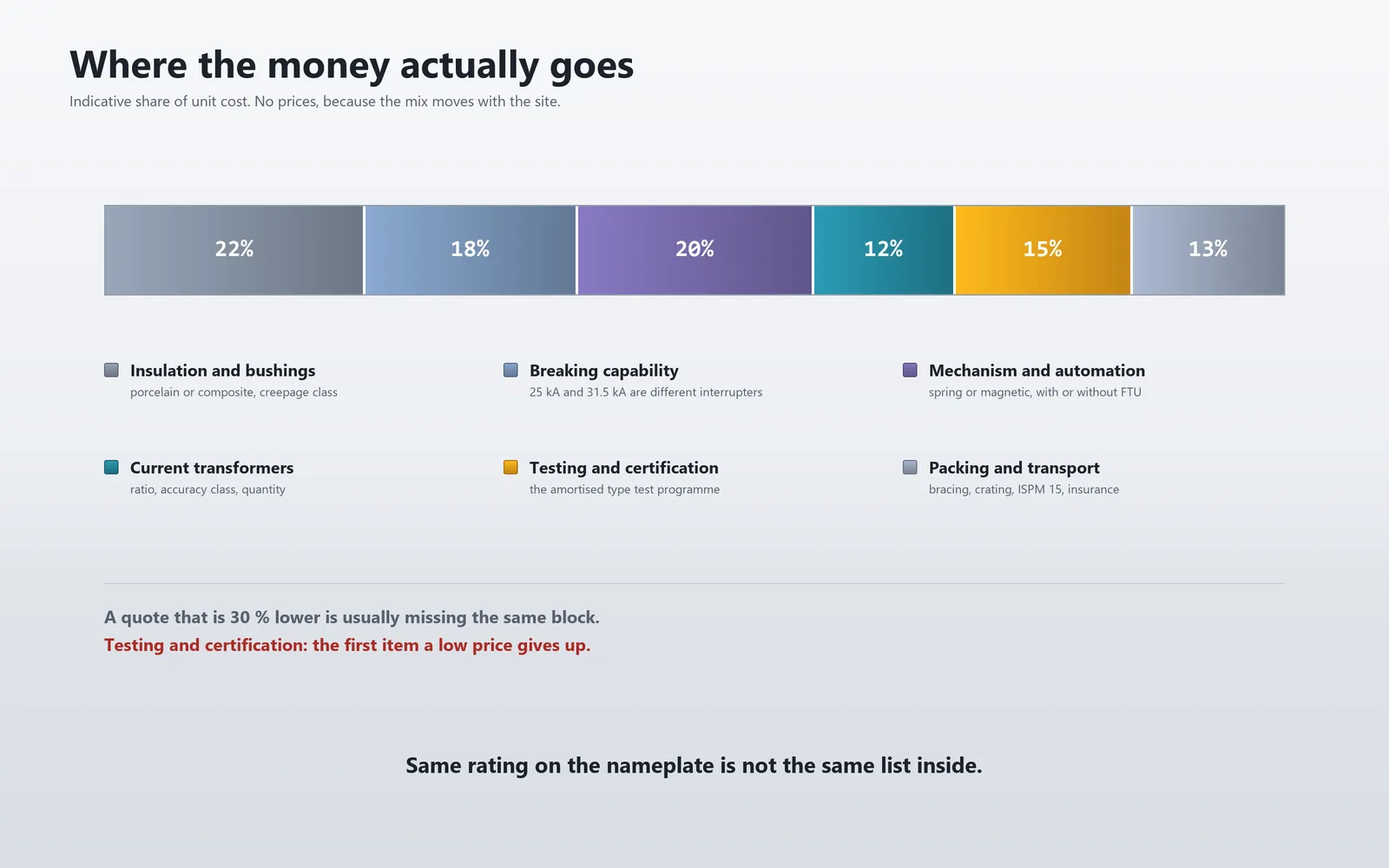
The difference sits exactly where the datasheet is thin: insulation one class down, creepage shortened, mechanism simplified, report absent. The cost arrives later as pollution flashover, a seized mechanism or a part that cannot be sourced. Compare responses to the same RFQ, not two totals.
Buying the right unit and getting it into service are two skills, and the second is where a good purchase is quietly undone.
Four items carry most of the information: circuit resistance by the four-wire method, power-frequency withstand, mechanical operation including every interlock, and the auxiliary circuits against the wiring drawing. For overseas projects, record video or invite a witness; that is cheaper than the dispute it prevents.
The bushing is the most fragile part in transit and the most expensive to replace on site, so it needs purpose-made supports and shock absorption. Sea freight adds desiccant and foil, salt-fog protection on exposed metal, and heat-treated crating with ISPM 15 marking.
After installation, record insulation resistance, circuit resistance and mechanical characteristics against the factory values. Before energisation, verify each interlock, commission the heaters and confirm CT polarity, by qualified personnel under the site's own switching procedures. This is where the six-step selection method hands over to acceptance.
The same five errors appear every year, and each is cheap to prevent at the enquiry stage.
1. Checking only three numbers. Voltage, current and breaking capacity are almost never wrong. Insulation level and creepage are the expensive omissions, and one added line blocks both.
2. Tendering a 36kV unit into a 35kV project. One insulation class short, rejected at acceptance, with the schedule already committed.
3. Leaving the pollution level out. A flashover in the first season costs more to retrofit than the correct specification would have cost to buy.
4. Treating the type test report as decoration. A report whose specimen does not match the ordered model proves nothing. Check the model before signing.
5. Comparing totals instead of spares and warranty. Interrupter, coil and auxiliary switch commonality decides maintenance cost for the next decade.
The line worth keeping is not about price at all. The cheapest 40.5kV breaker is the one you only buy once.
What is the difference between a 40.5kV and a 36kV vacuum circuit breaker?
Different systems: 40.5kV serves a 35kV nominal network, 36kV serves 33kV in the IEC world. Insulation differs at 95kV and 185kV against 70kV and 170kV, so they are not interchangeable in a tender.
Can a 40.5kV VCB be used on a 33kV system?
Usually yes, as an over-specified unit with more insulation margin, provided dimensions, CT ratios and protection settings match.
What breaking capacity do I need?
It follows from the prospective fault current at the installation point, commonly 25kA or 31.5kA here, checked as a group with short-time and peak withstand.
Is a porcelain or a composite bushing better outdoors?
Porcelain offers mechanical strength and a long record against UV ageing; composite is lighter and better in pollution and impact. For heavy pollution or difficult transport, composite often fits better.
What creepage distance should I specify?
Calculate from pollution level and highest voltage: 25 mm/kV gives about 1,013 mm at 40.5kV, 31 mm/kV about 1,256 mm. State the total figure, not the phrase “anti-pollution type”.
Does the breaker come with CTs and a controller?
It depends on the ordered configuration: ratio, accuracy class, quantity and any integrated FTU or DTU are fixed at order, not on site.
What standards should the type test report reference?
IEC 62271-100 for the breaker and 62271-1 for common requirements, or GB/T 11022 and GB 1984 domestically. IEC 60470 covers contactors.
What is the typical lead time?
It depends on configuration and quantity: integrated CTs, FTU or non-standard creepage take longer, and a new type test extends it. Confirm against the contract.
The cost of buying the wrong 40.5kV unit does not appear on the quotation. It appears on the night of the first pollution flashover, or at the acceptance meeting where a 36kV nameplate is read out loud.
Three actions follow, in this order. Fix the voltage system: 40.5kV equipment for a 35kV system, 36kV only where 33kV is the standard. Verify the six numbers, with insulation level and creepage read as part of the set. Then compare responses to one RFQ, line by line.
In the cluster, the selection guide works out what the numbers should be, this article checks whether the offered unit meets them, and the vacuum circuit breaker against SF6 comparison chooses the technology route.
Send us the system voltage, the prospective fault current, the pollution level and the site conditions. Our engineers will confirm the 40.5kV configuration that fits, state the type test evidence behind it, and quote against your RFQ line by line.
Chennuo Electric Technology Group Co., Ltd
Tel:+86 19303791130
Email:sales@chennuojt.com
Add:No. 9 Duyu Street, Luolong District, Luoyang City, Henan Province, China

