1. What Are Frame Type and Encapsulated Contactors? Before comparing, it helps to be precise about the terms. Most confusion in this debate comes ...
Before comparing, it helps to be precise about the terms. Most confusion in this debate comes from treating “encapsulated” as a single design, when it in fact covers two constructions with very different maintenance models. Let us define all three clearly.
In a frame type vacuum contactor, the vacuum interrupters are mounted exposed on a metal frame. Phase-to-phase and phase-to-earth insulation is provided by air clearance, assisted by insulating barriers and supports inside the switchgear cabinet. Air is the primary dielectric.
The advantages follow directly from that design. The construction is simple, heat leaves the conductor by air convection, and the interrupters are visible and accessible. Because the insulation level depends on the air gap and on the cleanliness of the insulating parts, the cabinet environment matters a great deal. For a frame type vacuum contactor, good housekeeping is part of the electrical design.
In an encapsulated vacuum contactor, the interrupter is enclosed in solid insulation — either cast in epoxy resin or fitted inside an insulating cylinder. Here the dielectric is solid rather than air.
Encapsulation removes surface contamination and condensation from the equation, allows phase spacing to be compressed, and improves resistance to hostile environments. Within this family, however, two constructions must not be confused:
· Insulated cylinder type — the interrupter is inserted into a separate insulating cylinder and is usually removable.
· Epoxy cast / embedded pole type — the assembly is cast as one piece and is normally not dismountable.
That distinction matters later, when we discuss maintenance. If your specification requires the interrupter to be replaceable on site, the construction is the deciding factor, not the brand.
“Clean and dry — frame type. Dirty, damp or corrosive — encapsulated.”
That single line gets most engineers 80% of the way. The remaining 20% is where money is won and lost, and it is what the next three sections cover.
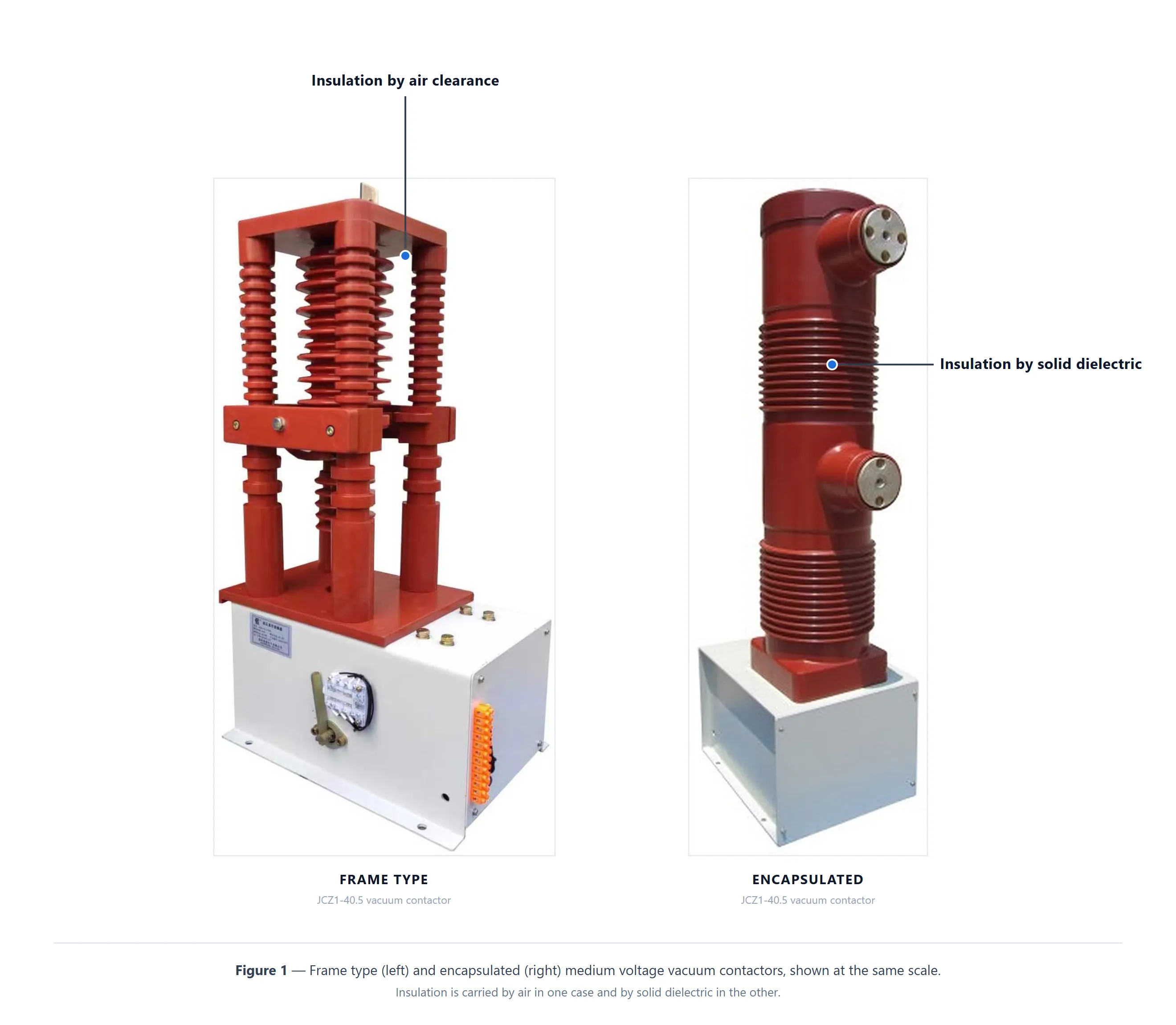
The table below sets out the differences that matter in specification work. It gives facts rather than conclusions on purpose — read it against your own conditions, and the right answer usually becomes obvious.
|
Comparison |
Frame Type |
Encapsulated |
|
Insulation method |
Air clearance + insulating parts |
Solid insulation (epoxy / insulating cylinder) |
|
Interrupter visibility |
Visible, can be inspected |
Enclosed, not visible |
|
Cooling path |
Air convection (good heat removal) |
Solid conduction (temperature rise typically higher at the same rating — verify data) |
|
Phase spacing |
Larger, limited by air insulation |
Can be compressed, saving cabinet width |
|
Contamination / condensation |
Depends on cabinet environment control |
Inherent — solid surface does not accumulate conductive deposits |
|
Corrosion / salt spray |
Metal frame parts exposed to attack |
Epoxy surface resists chemicals and salt spray |
|
Maintenance approach |
Contact area can be cleaned; interrupter often replaceable |
Interior maintenance-free; cast designs usually replaced as a whole |
|
Typical purchase cost |
Lower |
Higher |
|
Typical applications |
Indoor substations, controlled environments |
Cement, mining, chemical, metallurgy, coastal, water treatment |
Frame type contactors shed heat by air convection: the path is short and efficient. Encapsulation changes that path to solid conduction. The epoxy that provides such good insulation is also a good thermal insulator — that is the strength of the design, and also its cost.
The engineering consequence is that at the same current rating, an encapsulated contactor typically runs hotter than a comparable frame type. This does not mean encapsulated units cannot carry heavy current. It means that selection cannot stop at the rated current. You must check the temperature-rise test data and the derating curve for the specific encapsulated construction.
Buyers who miss this point tend to discover it in service, as an unexpected temperature rise at the terminals. It is one of the most common specification gaps we see in enquiries.
A frame type contactor can be opened, cleaned and inspected. If an interrupter fails, in many designs it can be replaced individually, keeping downtime short.
An encapsulated contactor is maintenance-free on the inside — but in the fully cast construction, a failed interrupter usually means replacing the whole pole. The correct management strategy for encapsulated units is therefore condition-based: track operation counts and contact-resistance trends, and plan replacement before failure rather than after.
Frame type is a device you can open and inspect. Encapsulated is a device you trust and monitor.
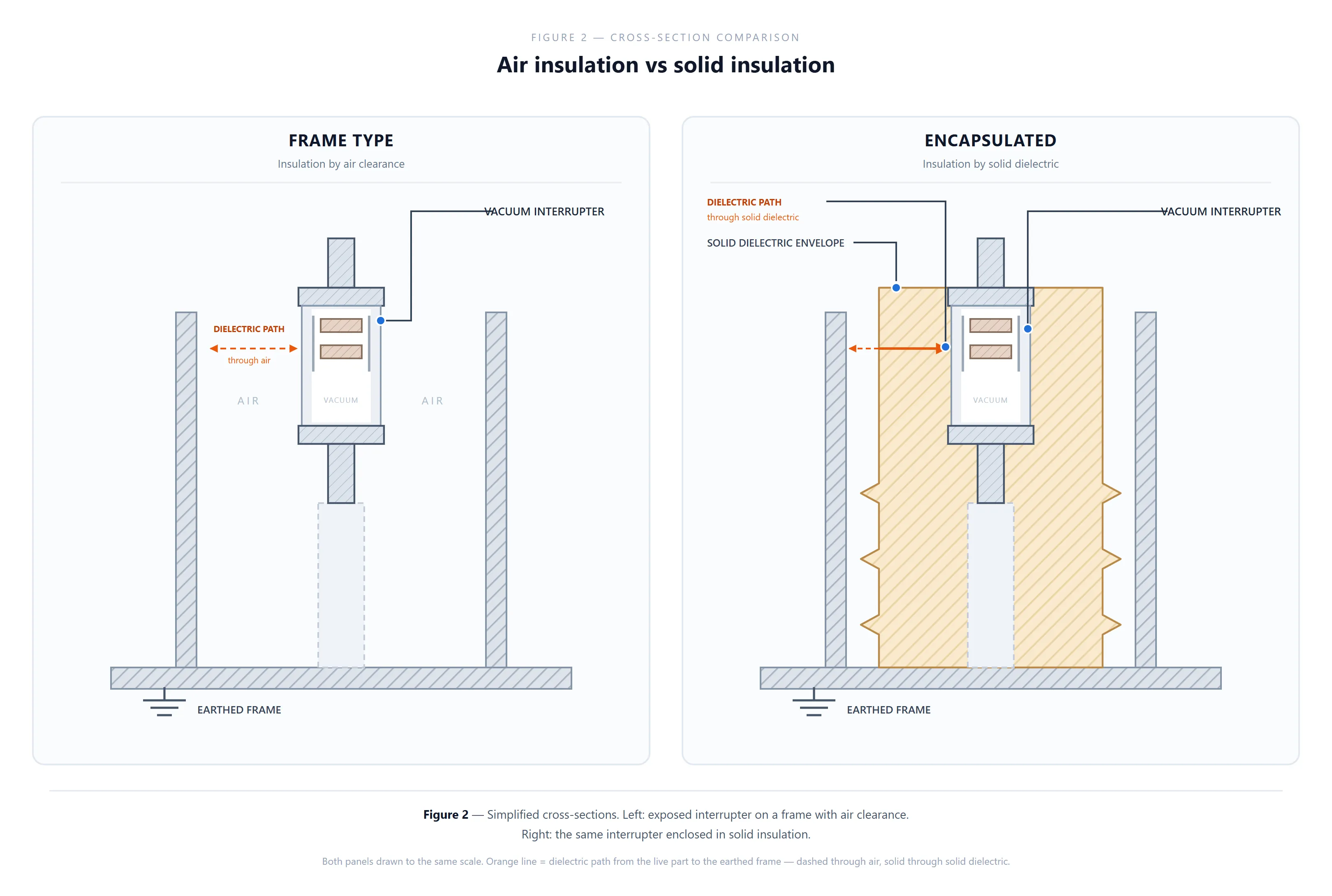
Comparisons that stay vague are useless. Below, each factor is scored with a clear verdict, together with the reasoning — so you can extend the logic to conditions we have not listed.
Dust settles on the exposed insulating parts of a frame type contactor in cement plants, mines and foundries. Once damp, that layer can become a conductive path across the surface. Humidity and condensation do the same in water treatment plants, underground pumping stations and coastal sites.
Corrosive gases and salt spray attack metal frame components on chemical, petrochemical and offshore installations. Against contamination, moisture and corrosion, solid insulation has essentially no competitor. Where any of these three is present, encapsulated is the safer specification.
For the same conductor cross-section, air convection removes heat more effectively than solid conduction. In high-current, high-duty applications, or where the cabinet is well ventilated, a frame type design generally offers more thermal headroom.
The caveat is symmetrical: encapsulated units are not barred from heavy current, but selection must leave adequate derating based on that construction’s temperature-rise data.
Frame type suits users with maintenance capability who can schedule an outage: it can be cleaned, inspected and, in many designs, repaired at the interrupter level.
Encapsulated suits users with the opposite profile — unattended sites and continuous-process industries where an unplanned outage costs far more than the equipment. For them, the absence of internal maintenance is the whole point.
Solid insulation carries a higher dielectric margin than air at the same distance, so phase spacing and clearances can be compressed. That translates into a narrower cabinet, and for switchgear builders, either a higher voltage class or more outgoing circuits in the same width. In retrofit projects it can mean an upgrade without rebuilding the enclosure.
Frame type is usually cheaper to buy. Encapsulated costs more per unit but can repay the difference over its life in avoided cleaning outages, replaced insulating parts, and the continuous power drawn by anti-condensation heaters in cabinets that depend on environmental control.
The practical test is to put the numbers side by side: five years of maintenance events multiplied by the cost of each outage, against the higher purchase price. In dirty or humid plants, the answer usually emerges on its own.
|
Dimension |
Winner |
Key reason |
|
Contamination / humidity / corrosion |
Encapsulated |
Solid insulation is immune to surface deposits and condensation |
|
Cooling and current headroom |
Frame type |
Air convection gives a shorter thermal path |
|
Serviceability and replaceability |
Frame type |
Visible, cleanable, individually replaceable |
|
Maintenance-free / unattended operation |
Encapsulated |
No internal surface on which deposits can form |
|
Compact cabinet / phase spacing |
Encapsulated |
Higher dielectric margin of solid insulation |
|
Purchase cost |
Frame type |
Simpler structure, lower material cost |
|
Life-cycle cost |
Depends on duty |
Encapsulated wins where maintenance frequency is high |
This is the part most readers come for. Find the row that matches your conditions.
|
Your condition / requirement |
Recommended construction |
Why |
|
Controlled indoor substation environment |
Frame type |
Better cooling, lower cost, easy maintenance |
|
Cement, mining, metallurgy (high dust) |
Encapsulated |
Dust cannot settle on the insulating surface |
|
Water treatment, underground pumps, coastal (high humidity) |
Encapsulated |
Eliminates condensation-driven surface tracking |
|
Chemical / petrochemical (corrosive gas) |
Encapsulated |
Epoxy surface resists chemical attack |
|
Offshore platforms, marine (salt spray) |
Encapsulated |
Salt-spray resistant; no exposed metal frame parts |
|
High current, long continuous duty |
Frame type |
Greater thermal headroom by air convection |
|
Unattended operation, very high outage cost |
Encapsulated |
Maintenance-free interior; fewer unplanned stops |
|
Restricted cabinet space / retrofit project |
Encapsulated |
Phase spacing can be compressed |
|
On-site visual inspection of contacts required |
Frame type |
Interrupters are visible |
|
Budget-sensitive, with in-house maintenance team |
Frame type |
Lower purchase and replacement cost |
For those who prefer not to work through the table:
1. Is the environment clean and dry? If yes, frame type is usually adequate. If no, go straight to encapsulated.
2. Is maintenance available, and can outages be scheduled? If yes, frame type is workable. If not, encapsulated is the safer choice.
3. Is there enough thermal margin in the cabinet? If you choose encapsulated, verify the temperature-rise and derating data for that construction before committing.
Three questions, in that order, resolve the majority of cases.
In real projects the answer is often a mix. A common and entirely sound approach is to use frame type contactors on the incoming and high-current circuits, where cooling and cost favour them, and encapsulated units on feeder circuits exposed to dust, humidity or corrosive atmosphere.
This is routine practice in switchgear assembly, and it is worth remembering that the choice is not a matter of doctrine. It is an engineering trade-off, and a mixed specification is sometimes the most economical answer.

A few persistent beliefs distort this decision more than any technical factor. Each is addressed below as the misconception, the fact, and what to do about it.
|
Misconception |
Fact |
|
“Encapsulated is the new generation; frame type is obsolete.” |
They are trade-offs , not generations. In controlled environments, high-current duty and sites that need on-site maintenance, frame type remains a reasonable and common choice. |
|
“Encapsulated contactors need no maintenance at all.” |
The interior is maintenance-free, but the actuator, control circuit and external connections still need periodic inspection . Because the interrupter is not visible, management must rely on operation counts and contact-resistance trends. |
|
“Encapsulated contactors have no overvoltage problem.” |
Overvoltage comes from current chopping and reignition in the vacuum interrupter itself , not from the housing. Both constructions should be specified with an RC snubber or zinc-oxide arrester according to duty. |
|
“Frame type has exposed contacts, so it is unsafe.” |
“Exposed” means not enclosed in solid insulation inside the cabinet — it does not mean exposed to personnel. With correct cabinet and environment design, frame type meets insulation requirements. |
|
“Encapsulated units can be uprated freely on current.” |
The opposite is true — the solid insulation path is worse at removing heat , so temperature rise is typically higher at the same rating. Overloading risk is greater, not smaller. |
|
“Both types have the same life.” |
Interrupter electrical life is comparable. The difference lies in how fast the external insulation degrades and in serviceability — and that is the real dividing line in life management. |
The first and fourth deserve particular attention. We encounter both frequently in after-sales discussions, and answering them directly is usually enough to tell whether a supplier is giving advice or making a sale.
What is the difference between frame type and encapsulated vacuum contactors?
In a frame type contactor, insulation is provided by air clearance and the interrupters are visible. In an encapsulated contactor, the interrupter is enclosed in epoxy or an insulating cylinder, so insulation is provided by solid dielectric.
Which is better for a dusty environment?
Encapsulated. Dust that settles on the insulating parts of a frame type contactor can form a conductive path once damp, whereas a solid insulating surface does not accumulate deposits in the same way.
Are encapsulated vacuum contactors more reliable?
In hostile environments, yes. In controlled environments where thermal margin is tight, a frame type design — with better air-convection cooling — can be the more comfortable choice.
Do encapsulated contactors need maintenance?
The interior is maintenance-free, but the actuator, control circuit and external connections still require periodic inspection, and operation counts and contact-resistance trends should be tracked.
Can I replace the vacuum interrupter in an encapsulated contactor?
It depends on the construction. Insulating-cylinder types are usually removable; fully cast embedded poles are normally replaced as a unit. Confirm with the manufacturer before purchase.
Why do encapsulated contactors sometimes need current derating?
Because encapsulation changes the cooling path from air convection to solid conduction, temperature rise is typically higher at the same rating. Selection must follow the temperature-rise test data and derating curve.
Frame type and encapsulated vacuum contactors are not a story of new replacing old. They are two engineering answers to two different sets of conditions.
The decision rule is straightforward: environment decides the construction, cooling decides the rating, and maintenance capability decides the life-cycle cost.
If you have followed this series, the sequence is now complete: how a vacuum contactor works, how long it lasts, how to select one for a motor, and how to choose between the two constructions. That is the full path from first principle to purchase decision.
Still deciding between frame type and encapsulated? Send us your environment conditions — dust, humidity, altitude, corrosive media — and our engineering team will recommend the construction and rating that fits, with datasheets and dimension drawings for both options. Contact us.
Chennuo Electric Technology Group Co., Ltd
Tel:+86 19303791130
Email:sales@chennuojt.com
Add:No. 9 Duyu Street, Luolong District, Luoyang City, Henan Province, China

