1. What Is a Vacuum Contactor? Before we look inside the device, it is worth being precise about what it is — and about the one device it is most ...
Before we look inside the device, it is worth being precise about what it is — and about the one device it is most often confused with.
A vacuum contactor is a switching device that repeatedly connects and disconnects an electrical load — most often a motor — using contacts that operate inside a vacuum.
That is the whole idea. The unusual part is the phrase "inside a vacuum." Almost every other switch in the world, from a household light switch to an air-break contactor, opens its contacts in air. A vacuum contactor opens them in nothing at all.
Why that single difference matters is the subject of this article.
Two devices with similar-sounding names do two very different jobs.
|
|
Vacuum contactor |
Vacuum circuit breaker |
|
Primary job |
Frequent switching of load current |
Fault interruption (short-circuit current) |
|
Typical number of operations |
Hundreds of thousands |
Usually few |
|
Life measured in |
Electrical life (operations) |
Rated short-circuit breaking operations |
|
Typical application |
Motors, capacitor banks, transformers |
Feeder protection, system isolation |
|
Key selection factor |
Utilization category and electrical life |
Rated short-circuit breaking current |
A memory hook: the contactor handles the everyday; the circuit breaker handles the emergency. In practice they work together rather than replacing one another.
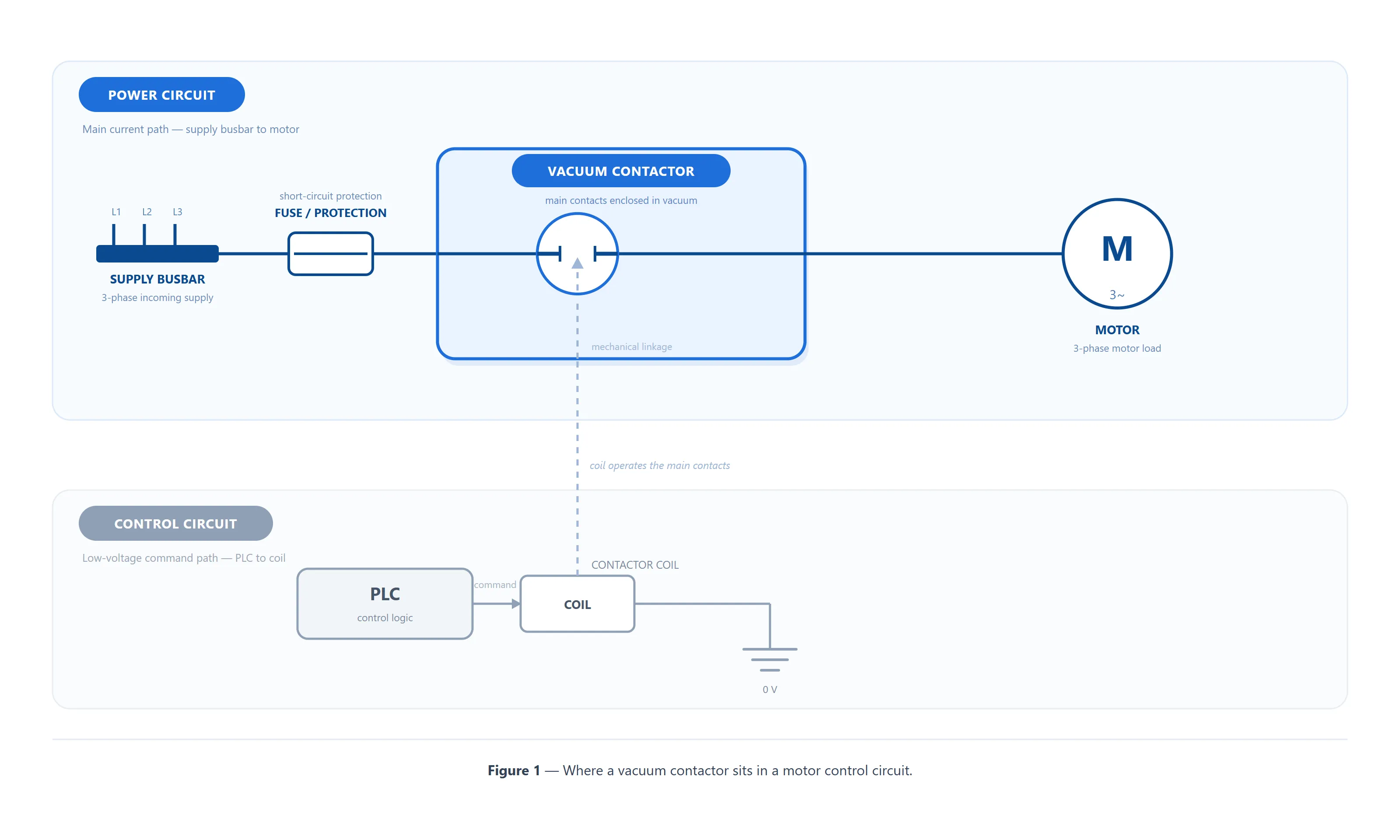
A vacuum contactor is mounted inside switchgear and wired in series along a simple path: supply busbar → protection (fuse or relay) → contactor → motor. A low-voltage control supply drives it, usually following a start/stop command from a PLC or DCS.
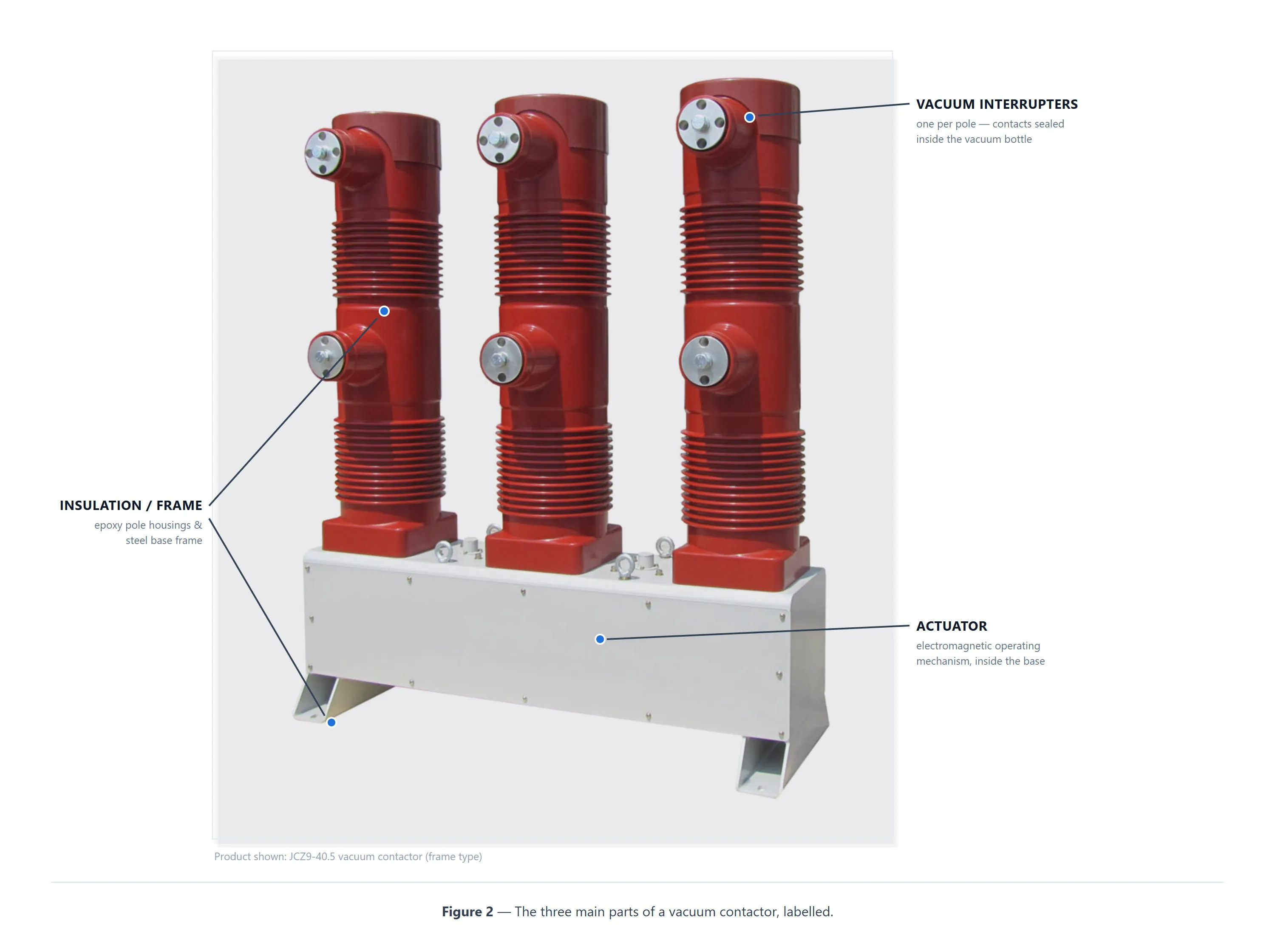
Every vacuum contactor — whether rated 7.2 kV or 40.5 kV — is built from the same three functional blocks. Learn these three and you can read any model you meet.
The interrupter is the only part that actually carries and interrupts the current. It is a sealed unit with an internal vacuum of roughly 10−4 Pa or better, and it is maintenance-free for its entire service life. A single-phase contactor contains one interrupter; a three-phase contactor contains three.
The actuator supplies the mechanical force that closes and opens the moving contact. Two designs dominate today: the permanent magnetic actuator and the electromagnetic actuator. The permanent magnetic type uses fewer parts, consumes almost no power while holding, and delivers highly consistent motion — which is why it has become the mainstream choice for MV contactors over the past two decades.
The frame and insulation support the interrupter, insulate it from earth, and protect it from the environment. There are two mainstream constructions:
· Frame type — the interrupter is visible; straightforward to inspect and service.
· Encapsulated (insulated-cylinder) type — the interrupter is fully cast or enclosed, sealing it against dust and moisture. This construction suits harsh environments such as petrochemical plants, cement works and mines.
|
Part |
What it does |
Key characteristic |
Maintenance |
|
Vacuum interrupter |
Makes and breaks current |
Sealed vacuum; carries and interrupts the current |
Maintenance-free (managed by operation count) |
|
Actuator |
Drives the contacts |
Permanent magnetic or electromagnetic; sets mechanical life |
Periodic check of lubrication and timing |
|
Insulation and frame |
Supports, insulates, protects |
Frame type or encapsulated type |
Surface cleaning and insulation checks |
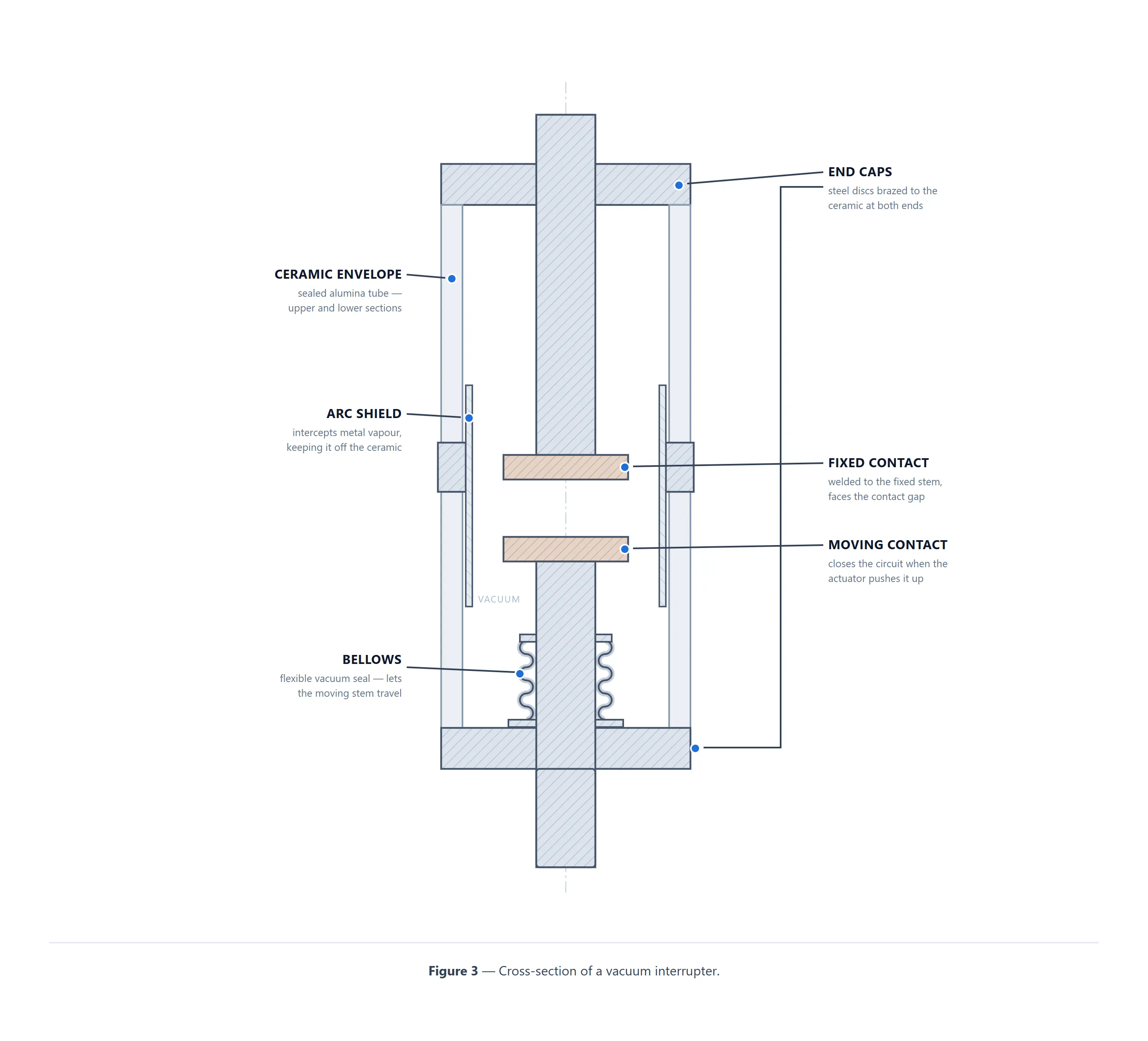
This is the part readers most want to see. What is actually inside that ceramic bottle?
|
Component |
Plain-English role |
Engineering job |
|
Ceramic (or glass) envelope |
The bottle |
Insulates and holds the vacuum |
|
Fixed and moving contacts |
The pair of metal discs inside |
Carry and interrupt the current; usually a copper-chromium (CuCr) alloy |
|
Arc shield |
A metal cylinder surrounding the contacts |
Condenses metal vapour so it never coats the ceramic |
|
Bellows |
An accordion-like metal tube |
Lets the moving contact travel while keeping the unit airtight |
Two components do the quiet heavy lifting, and both are easy to overlook.
The bellows is a moving seal. The real engineering challenge in a vacuum interrupter is not the contacts — it is this corrugated metal tube, which must move with every operation while remaining perfectly airtight. Its fatigue life directly limits the mechanical life of the interrupter.
The arc shield decides how many operations the device can survive. Every arc releases metal vapour. The shield captures and condenses that vapour before it can reach the ceramic and form a conductive coating. Remove the shield and the interrupter would fail after a small fraction of its rated life.
Because the contacts never meet air, dust or moisture, contact resistance stays stable for years. That is the major reliability advantage of the design.
It also carries a cost worth stating plainly: you cannot inspect vacuum contacts visually. Unlike an air-break contactor, there is no cover to lift and no contact tip to measure. Condition must be tracked indirectly, through operation counts and contact-resistance trends.
An analogy that tends to stick: if an air-break contactor is an open fireplace, the vacuum interrupter is a sealed furnace — nothing gets in, nothing gets out, and it burns cleaner.
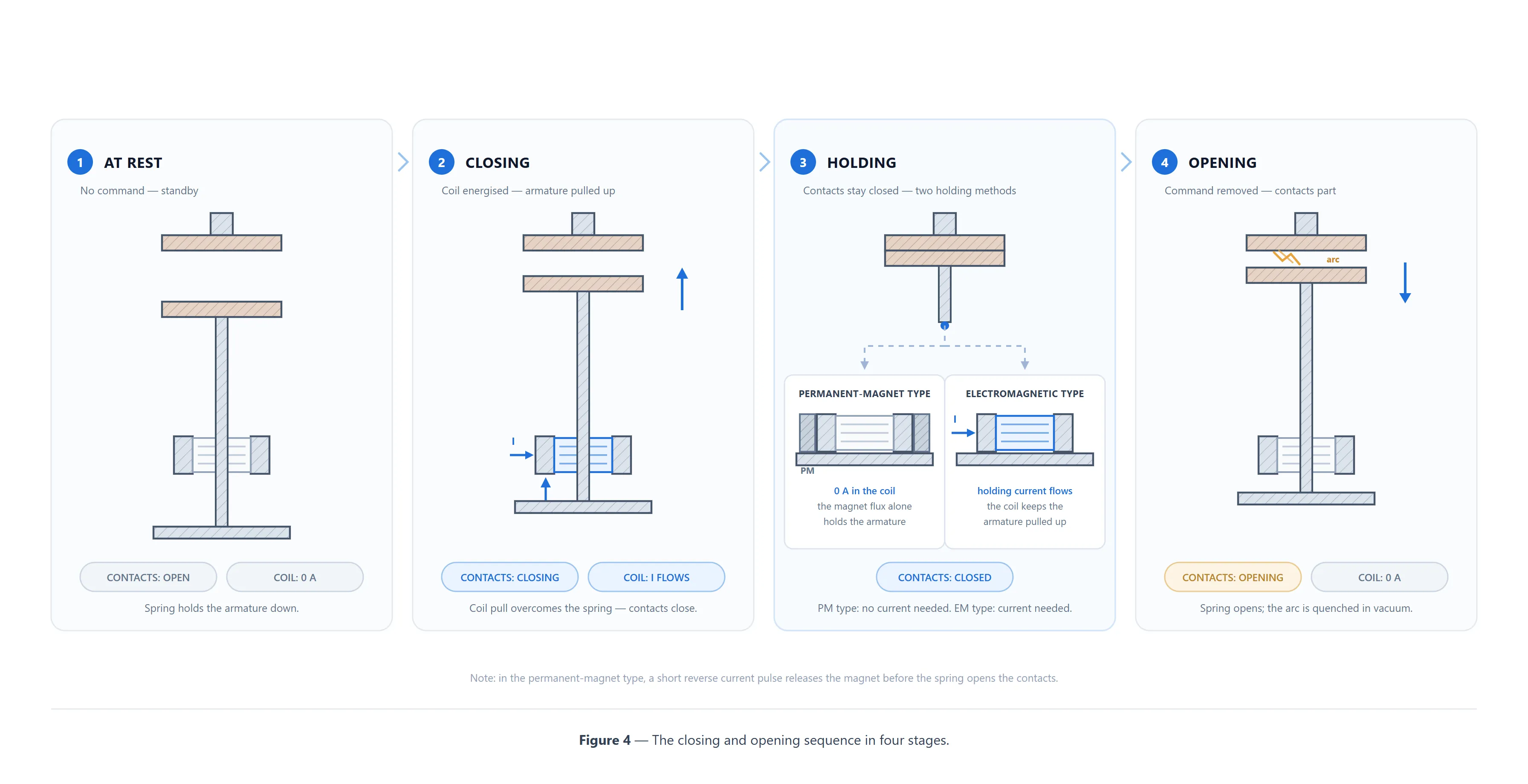
Four steps cover the entire operating cycle.
Step 1 — At rest (open). The contacts are apart and the load is de-energised. The mechanism holds the open position by spring force or permanent-magnet force. Note how small the gap is: because vacuum has such high dielectric strength, a few millimetres is enough to withstand kilovolts.
Step 2 — Closing. The control supply energises the coil. The actuator does work, and the moving contact snaps shut. Closing speed must be high — on the order of milliseconds — so the contacts do not dwell at the point of pre-strike and burn.
Step 3 — Holding. Once closed, the contacts are held either by permanent-magnet force or by continuous coil current. This is the key difference between the two actuator types. A permanent magnetic actuator draws almost no power and generates almost no heat while holding; an electromagnetic actuator must stay energised, with continuous consumption and temperature rise.
Contact pressure itself comes from the contact spring — and insufficient pressure raises contact resistance, which in turn causes heating.
Step 4 — Opening. The coil is energised in reverse (or a trip coil operates) and the contacts separate. An arc forms instantly between them — and is then "carried" to the next current zero, where it goes out. Opening speed and three-phase simultaneity are critical: unequal pole opening times shift the neutral point and can generate overvoltage.
|
Comparison |
Permanent magnetic actuator |
Electromagnetic actuator |
|
Holding method |
Permanent-magnet self-holding |
Continuous coil current |
|
Holding power |
Essentially zero |
Continuous draw, with heat rise |
|
Number of parts |
Few (no latch or trip mechanism) |
Comparatively more |
|
Motion consistency |
High; well suited to frequent operation |
More sensitive to control-supply variation |
|
Typical fit |
Frequent starting, maintenance-free duty |
Standard switching duty |
This is the counter-intuitive part. Many readers assume that interrupting current inside a vacuum must be harder. The opposite is true.
At 50 or 60 Hz, the current crosses zero twice per cycle — roughly every 10 ms at 50 Hz. The arc only exists within that window. Whether it survives the crossing depends on one thing: how fast the gap regains its dielectric strength at the zero instant.
In a vacuum there is no gas to ionise, so the arc is sustained only by metal vapour boiled off the contacts. The instant current reaches zero, the energy input collapses. The metal vapour disperses and condenses onto the arc shield within microseconds, and the contact gap regains its insulation almost immediately.
Measured recovery rates reach the kV/µs range — an order of magnitude beyond air-break or SF6 devices. The practical consequence is simple: the faster the arc is extinguished, the less contact erosion each operation causes, and the longer the electrical life. This is the same mechanism that sets the operating life of the device, viewed from the inside.
Knowing how the device works also reveals what it is not for. This section places the contactor alongside the two devices it is most often mixed up with.
|
Device |
Job |
Analogy |
|
Vacuum contactor |
Frequent switching of load current |
The skilled operator — fast, repeated action |
|
Fuse / protection |
Clears short-circuit fault current |
The last line of defence, single-use |
|
Vacuum circuit breaker |
Fault interruption plus system isolation |
The firefighter — rarely needed, decisive when it is |
"A contactor can break short-circuit current." It cannot, and it is not designed to. The contactor's design target is frequent operation; short-circuit protection belongs to the fuse or protective relay.
"The vacuum interrupter needs periodic servicing." It does not. It is sealed and maintenance-free. What does need attention is the actuator and the external environmental protection.
Two quick reference sections for readers who want to look something up rather than read straight through.
|
Term |
Plain-English meaning |
|
Vacuum interrupter |
A sealed vacuum tube containing a pair of contacts that make and break current |
|
Utilization category (AC-1 to AC-4) |
A rating of "how hard the work is," based on load type; it determines electrical life |
|
Electrical life |
How many on-load operations the device can survive — the real limiting factor |
|
Mechanical life |
How many no-load operations the mechanism can perform; usually far higher |
|
Current chopping |
The current being cut off early during vacuum interruption, which can cause overvoltage |
|
Permanent magnetic actuator |
An actuator that holds the closed position with permanent-magnet force, using almost no power |
|
Encapsulated (insulated-cylinder) type |
A construction in which the interrupter is fully cast or enclosed against dust and moisture |
How does a vacuum contactor work in simple terms?
It makes and breaks current between two contacts sealed inside a vacuum. Because there is no gas to ionise, the arc goes out the instant the current crosses zero.
What is inside a vacuum interrupter?
Four components: a ceramic envelope, a fixed and a moving contact, an arc shield, and a bellows. The whole assembly is sealed and maintenance-free.
Why is a vacuum better than air for arc extinction?
In a vacuum the arc is sustained only by metal vapour. At current zero that vapour condenses within microseconds, so the gap recovers its insulation at kV/µs rates — far faster than air.
Does a vacuum contactor need maintenance?
The interrupter itself does not. What needs periodic checking is the actuator's operating characteristics, contact resistance, insulation, and environmental protection.
Can a vacuum contactor break short-circuit current?
Generally no. Its role is frequent switching of load current. Short-circuit protection is provided by a fuse or protective device.
What is the difference between a vacuum contactor and a vacuum circuit breaker?
The contactor handles high-frequency switching; the circuit breaker handles fault interruption and isolation. They perform different jobs and are usually used together.
Every design decision in a vacuum contactor serves one goal: to let a pair of contacts sealed in a vacuum make and break current as often, and as cleanly, as possible. The vacuum interrupter does the switching, the actuator does the moving, and the frame keeps both working in whatever environment the plant provides.
Understanding that chain is the fastest route to understanding why the device is rated the way it is — and why knowing how long it lasts, and how to size it for your motor, are the natural next questions.
Not sure which vacuum contactor suits your application? Our engineering team can provide datasheets and cross-section drawings for 7.2 kV and 12 kV vacuum contactors, and will review your motor or capacitor-bank data to recommend the right rating. Contact us for a technical consultation.
Chennuo Electric Technology Group Co., Ltd
Tel:+86 19303791130
Email:sales@chennuojt.com
Add:No. 9 Duyu Street, Luolong District, Luoyang City, Henan Province, China

